Is your roofline failing? Identify the 9 urgent signs your soffit and fascia need replacing. Verified data on codes, costs ($6-$30/ft), and ventilation requirements.
Strategy Summary
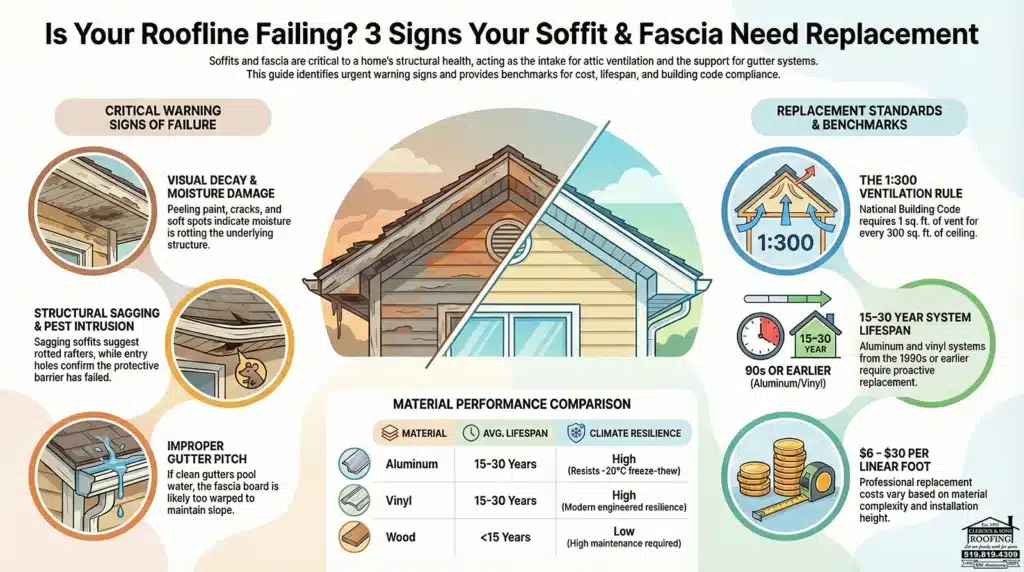
- Lifespan Benchmarks: Expect aluminum and vinyl systems to last 15–30 years, while wood often fails sooner without maintenance.
- Ventilation Standards: The National Building Code mandates a 1:300 ventilation ratio to prevent attic moisture and ice dams.
- Cost Reality: Professional replacement in Canada typically ranges from $6 to $30 per linear foot based on material complexity.
Visual Decay: Cracking, Peeling, and Material Failure
At Cleroux Roofing, we know that high-quality vinyl and aluminum are preferred in Canada specifically for their resilience to -20°C temperatures, which can cause inferior materials to crack during freeze-thaw cycles.
Sign #1: Flaking Paint and Cracking
- Wood Systems: Peeling paint often hides rotting timber beneath. Once water penetrates the paint barrier, the wood fascia board expands and contracts, accelerating decay.
- Vinyl/Aluminum: While durable, older systems may exhibit physical cracks or brittleness. Our inspection teams identify peeling paint and physical degradation as primary warning signs that the material’s protective capacity is compromised.
Sign #2: Visible Moisture Damage on Fascia
This is often exacerbated by poor maintenance; standard industry guidelines recommend cleaning gutters 2x yearly to prevent water from backing up and saturating the fascia.
Compromised Attic Ventilation and Airflow
Soffits are not merely decorative; they are the intake mechanism for your home’s respiratory system. Blocked or inadequate soffits lead to heat buildup in summer and condensation in winter.
Sign #3: Ice Dams and Attic Frost
If your attic lacks proper intake airflow, warm air gets trapped, melting snow on the roof which then refreezes at the eaves. This is a direct violation of building standards. Gentek notes that the National Building Code requires a strict 1:300 ratio for attic ventilation (1 sq. ft. of vent for every 300 sq. ft. of ceiling area). Failure to meet this ratio often necessitates a soffit retrofit.
Sign #4: Inadequate Net Free Airflow
Not all vented soffits are created equal. Modern aluminum soffit panels are engineered to provide specific airflow metrics. According to Gentek specifications, standard vented aluminum soffit should provide between 4.02 and 5.46 sq. in. of net free flow per linear foot. If your current soffits are painted over or clogged with insulation, they cannot achieve this metric, signaling an urgent need for replacement.
Structural and Installation Integrity Issues
Physical displacement of the eaves system threatens both drainage and pest control.
Sign #5: Sagging Soffits
Sagging indicates that the fasteners have failed or the rafters have rotted. Structural assessments highlight sagging as a critical structural red flag. This creates gaps where water can enter the roof void.
Sign #6: Improper Gutter Pitch
If the fascia is rotting or warped, gutters lose their required slope. Professional installation guides mandate a minimum slope of 1/4″ per 10ft to ensure proper drainage.
Sign #7: Pest Intrusion
Squirrels, raccoons, and birds exploit weak soffits to nest in attics. Evidence of pests—droppings, scratching sounds, or visible entry holes—confirms that your soffit barrier has failed.
Regulatory Compliance and Material Lifespan
Sometimes the sign for replacement is dictated by age or safety codes rather than visible rot.
Sign #8: Fire Code Non-Compliance
In denser Windsor neighborhoods, fire codes are strict regarding property lines. Government regulations (mirrored across many Canadian jurisdictions including Ontario) typically require “non-vented” fire-resistant soffit material within 1.2 meters of a property line. If you have vented vinyl soffits facing a neighbor’s wall within this distance, your home may be non-compliant and at higher risk during a fire event.
Sign #9: Exceeding Material Lifespan
Nothing lasts forever. Reporting states the average lifespan of modern aluminum or vinyl soffit and fascia systems in Canada is 15–30 years. If your home boasts the 3 primary materials (Aluminum, Vinyl, or Wood) installed in the 1990s or earlier, proactive replacement is often more cost-effective than reactive repairs.
Investment Analysis: Cost vs. Protection
Homeowners often delay replacement due to cost concerns, but the damage to roof trusses can be far more expensive.
- Cost Estimates: Current market analysis outlines a typical Canadian price range of $6 – $30 per foot for professional replacement. This variance depends heavily on the material chosen (aluminum vs. wood) and the height/accessibility of the install.
- Value Proposition: New fascia protects the roof deck from water rot, while new vented soffits lower attic temperatures, extending shingle life.
Secure Your Home’s Perimeter Against Windsor’s Elements
Ignoring the warning signs of soffit and fascia failure leads to cascading structural issues, from mold-filled attics to rotted rafters. With modern aluminum and vinyl options offering 15 to 30 years of protection, immediate replacement is a decisive step toward long-term home health. Ensure your property meets the 1:300 ventilation code and stands resilient against Canadian winters by addressing these 9 critical signs today.
Contact Cleroux Roofing today to protect your roof for years to come.