The question isn’t usually “if” your roof needs replacing—it’s “when.” In Canada, where we contend with freeze-thaw cycles, heavy snow loads, and seasonal extremes, your roof faces unique pressures that accelerate wear and degradation. I’ve inspected thousands of roofs across the country, and I can tell you that most homeowners wait too long. Let me walk you through exactly how to know when your roof is ready for replacement.
The Non-Negotiable Rule: Age Your Roofing Material
The easiest way to start is knowing what’s on top of your head and how old it is.
| Roofing Material | Expected Lifespan in Canada | Actual Replacement Range | Notes |
|---|---|---|---|
| 🧱 Asphalt Shingles (3-tab) | 15–20 years | 12–18 years | Most common. Shorter life in harsh climates. |
| 🏗️ Asphalt Shingles (architectural/laminate) | 20–25 years | 15–22 years | Better durability than 3-tab, but still vulnerable to UV and ice dams. |
| 🌲 Wood Shakes/Shingles | 25–40 years | 20–35 years | High maintenance. Moss, rot, and splitting accelerate replacement. |
| 💪 Asphalt Shingles (premium/impact-rated) | 25–30 years | 20–28 years | Better hail resistance; popular in Prairie provinces. |
| 🪨 Metal Roofing | 40–70 years | 35–60 years | Exceptional longevity. Most durable option for Canadian climate. |
| 🏰 Slate Tiles | 50–100+ years | 40–80+ years | Premium option. Can last generations with proper maintenance. |
| ⚙️ Composite/Synthetic Slate | 30–50 years | 25–45 years | Engineered to mimic slate; more affordable. |
| 🧰 Flat Roofing (TPO, EPDM, PVC) | 15–20 years | 12–18 years | Requires professional installation and maintenance. |
Here’s the reality: These timelines assume regular maintenance and average climate exposure. In Windsor-Essex or other regions with aggressive winters, you’ll likely land on the shorter end of these ranges.
Red Flags: Signs Your Roof Needs Replacement (Not Just Repair)
Age alone doesn’t tell the whole story. Watch for these warning signs:
Visual Indicators (Inspect from the ground or safely with binoculars)
- Curling, Cupping, or Blistering Shingles Shingles that curl up at the edges or blister have lost their ability to shed water effectively. This typically appears after the 15-year mark on asphalt shingles. Once you see this, you’re on borrowed time.
- Missing or Cracked Shingles A few missing shingles? That’s a repair. Large patches? Widespread cracks? That’s a replacement signal. In Canada, winter weather dislodges shingles at an alarming rate if the roof is nearing end-of-life.
- Granule Loss New asphalt shingles should have embedded granules that protect the asphalt layer underneath. If you’re finding granules in your gutters (they look like black sand), your shingles are deteriorating. Heavy granule loss means 3–5 years of useful life remaining at most.
- Moss, Algae, or Lichen Growth This is more common in coastal regions and areas with high humidity, but it happens across Canada. Growth indicates moisture retention—a sign your roof is no longer shedding water as designed. If it’s extensive, replacement is likely soon.
- Sagging Deck A visible sag or dip along the roofline suggests structural compromise beneath the shingles, usually from long-term water infiltration and wood rot. This is urgent—don’t delay.
Interior Signs (Even More Critical)
- Water stains on ceilings or upper walls
- Mold or mildew in the attic
- Daylight visible through the roof deck
- Soft spots or rotting wood in the attic
Any of these means water has breached the outer layers. You need professional assessment immediately.
The Climate Factor: How Canadian Winters Accelerate Roof Failure
| Climate Stress | How It Affects Your Roof | What to Watch For | Regions Most Affected |
|---|---|---|---|
| ❄️ Freeze–Thaw Cycles | Water penetrates micro-cracks, freezes, expands, splits shingles further. Accelerates degradation by 30–50%. | Extensive cracking after winter; increased granule loss. | Southern Ontario, Atlantic Canada, Prairie provinces |
| 🌨️ Heavy Snow/Ice Load | Adds structural stress; ice dams form along gutters, forcing water under shingles. | Premature wear along eaves; water damage in top-floor rooms; shingle displacement. | British Columbia, Alberta, Quebec, Ontario |
| 🌡️ Temperature Swings | Shingle material expands and contracts; fasteners loosen; flashing separates. | Nails popping up; flashing gaps widening; fasteners visible. | All provinces; worst where temps swing 30°C+ seasonally. |
| 🌞 UV & Sun Exposure | Fades and hardens asphalt, making it brittle. Summer heat softens it; winter cold makes it crack. | Rapid granule loss; brittleness; cupping and curling accelerated. | Prairie provinces (Alberta, Saskatchewan); high-altitude areas. |
| 🌬️ High Wind Events | Lifts shingles; tears edges; dislodges flashing. | Missing shingles; torn shingles; exposed nails; flashing damage. | Coastal BC; Prairies (wind corridors); Great Lakes region. |
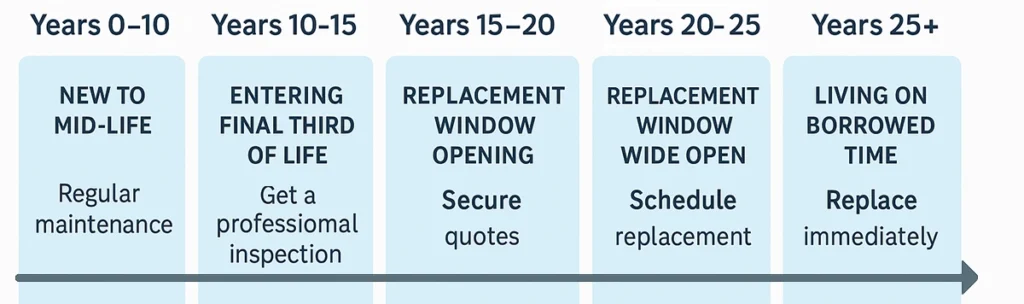
The Five-Year Windows: A Decision Framework
Use this timeline to plan ahead rather than react to emergency roof failure.
Material-Specific Guidance for Canadian Homeowners
Asphalt Shingles (70% of Canadian homes)
Most affordable upfront. Most common failure point: 15–18 years in harsh climates. Watch for granule loss and curling. Replacement cost: $6,000–$12,000+ depending on roof complexity and region.
Metal Roofing
Premium upfront ($12,000–$25,000+), but exceptional longevity. Ideal for Canadian climate because it sheds snow/ice and handles freeze-thaw cycles beautifully. Little to no maintenance. If budget allows, this is the best choice for Canadian properties.
Wood Shakes/Shingles
Beautiful but demanding. Requires annual treatment (moss removal, staining/sealing). Life is shortened dramatically without maintenance. Not recommended in regions with high moisture or significant shade. Replacement cost: $15,000–$30,000+.
Flat Roofing (Commercial or Modern Residential)
Most critical to replace on schedule. Ponding water is your enemy. Membranes (TPO, EPDM, PVC) deteriorate faster than pitched roofs in Canadian climate. Inspect every 2 years after year 10. Replacement cost: $5,000–$15,000+ depending on size and material type.
The Financial Case: Why Waiting Usually Costs More
Procrastination doesn’t save money—it just moves the cost from your roof to your walls, insulation, and attic structure. A failed roof doesn’t just need replacing; it causes cascading damage.
A Canadian-Specific Consideration: Warranty & Insurance
When you replace your roof, get a manufacturer’s warranty (usually 15–25 years) and a workmanship warranty from the installer (usually 10 years). In Canada, some regions offer preferential insurance premiums for newer roofs, so replacement can lower your insurance costs.
Also: If your roof is over 20 years old and you haven’t replaced it, tell your insurance company now. Failure to disclose may void coverage if a roof-related claim occurs.
The Bottom Line: When Should You Redo Your Roof?
- If your roof is 18+ years old and you haven’t replaced it, get a professional inspection this year. No exceptions.
- If you see water damage indoors, don’t wait for the roof to fail completely—this costs tens of thousands more.
- If you see curling, missing shingles, or heavy granule loss, you’re in the replacement window. Get quotes within 90 days.
- If you plan to sell, replace the roof if it’s over 15 years old. Buyers (and their lenders) will demand it anyway, and you’ll lose negotiating power.
- If your roof is 25+ years old, replace it. Period. You’re gambling with water damage and structural integrity.
In Canada, where weather is merciless and seasons are extreme, your roof earns its keep. Treat it as essential infrastructure, not optional home improvement. Inspect it annually, address problems early, and replace it on schedule. Your home—and your wallet—will thank you.
Have questions about your specific roof? Speak with Cleroux & Sons Roofing. It’s the best investment in home maintenance you can make.